
ComparisonDNS filtering alternatives
Cloudflare Gateway vs Purple Shield for venue WiFi
Decide whether Cloudflare Gateway or Purple Shield should filter DNS on your venue networks, based on one question: can you enroll the devices? You can score both on eight criteria, see where per-SSID and per-VLAN policy matters, and plan a six-step move from Gateway location policies to Shield with no new hardware.
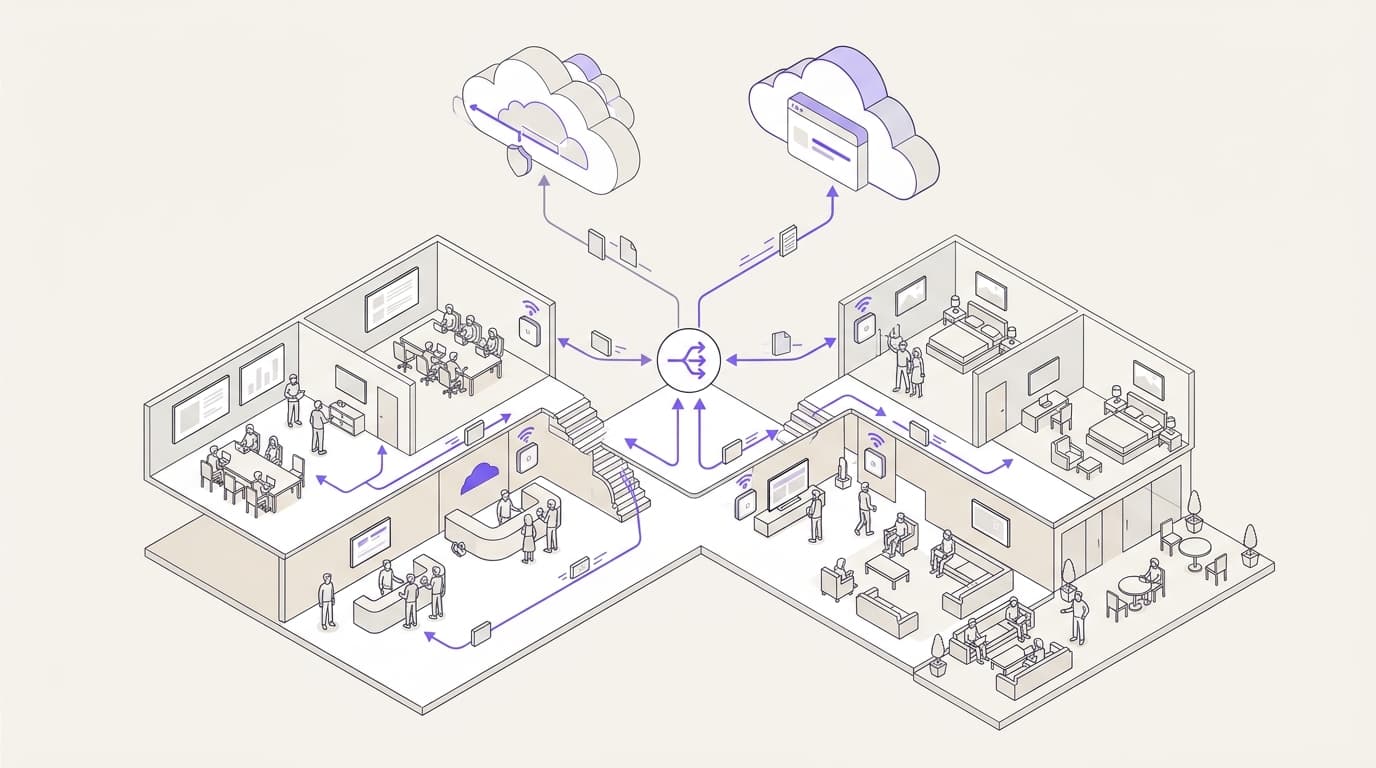
Watch the explainer
For venue guest WiFi, Purple Shield is the better fit. It filters DNS per SSID, VLAN and venue from one dashboard, needs no client on visitor devices, and runs at Whitbread and AGS Airports. Cloudflare Gateway is built for a different job: managed staff devices running the WARP client inside a Cloudflare Zero Trust estate.
Cloudflare Gateway or Purple Shield: which should a venue choose?
The verdict for venues is Shield, on one condition: the devices you need to protect are devices you do not manage. That covers almost every guest network. It also covers resident networks in multi-family (MDU) and student housing, and most staff networks in hospitality and retail.
The axis that flips the answer is device control. Cloudflare Gateway is the filtering engine inside Cloudflare One, Cloudflare's Zero Trust platform. Its DNS policies can apply to a whole site. Its identity rules, network policies and HTTP inspection depend on the Cloudflare One Client (formerly WARP) running on each device. You can enroll a staff laptop. You cannot enroll a guest's phone in a hotel lobby or a passenger's tablet at a departure gate.
Shield works at the network instead. It is protective DNS. Each device on the SSID (the network name) asks Shield to resolve a domain. Shield refuses anything malicious or outside policy before a connection opens. Nothing is installed on the device. You set a policy per SSID, VLAN and venue in one dashboard, on the WiFi you already run.
Some estates limit filtering to managed laptops already enrolled in WARP. Gateway sees that traffic. Shield then covers every venue network those laptops share with guests, residents and visitors.
- Up to 44%less data with ad blockingPurple data
- Up to 62%fewer DNS queriesPurple data
- 500M+users and logins a yearPurple
- 80,000+venues in 90 countriesPurple
Which criteria decide Cloudflare Gateway vs Shield?
We scored both products on eight criteria. Each one maps to a question venue IT teams raise when they build a shortlist. We used each vendor's own public material: the Cloudflare One developer documentation for Gateway, and Purple's product material and customer data for Shield.
- Placement. Where in the connection the filter acts, and what it can and cannot see.
- Device requirement. Whether a visitor's device needs a client, profile or certificate.
- Policy unit. Whether you can set a different policy per SSID, VLAN and venue.
- Identity. How rules follow a person rather than a network.
- Threat intelligence. How quickly new malicious domains are caught.
- Bandwidth effect. Whether filtering reduces data and DNS load on constrained venue links.
- Hardware. What the product needs from the access points and firewalls you already own.
- Design center. The environment each product was built for, and who runs it day to day.
Why placement comes first
DNS is the first step of almost every connection. A device must turn a domain name into an IP address before it can open a session. A protective DNS resolver refuses to answer for a phishing or malware domain. No packet reaches the destination.
A firewall sees the session only after the device already has an address. Encrypted traffic then hides most of what the firewall would need to judge it. DNS filtering catches what a firewall misses because it acts earlier. The Cybersecurity and Infrastructure Security Agency runs protective DNS services for the public sector on the same principle.
Gateway and Shield both sit at this resolver layer, as does Cisco Umbrella. We cover it in Shield vs Cisco Umbrella and a Cisco Umbrella alternative for guest WiFi. Umbrella also offers a roaming module for managed devices, so the device-control question applies to it too.
Two lanes show a visitor phone filtered by Shield at the venue network and a staff laptop filtered by Cloudflare Gateway through the WARP client.
Connections
- Visitor phone on guest SSID to SSID and VLAN (joins)
- SSID and VLAN to Shield protective DNS (DNS query)
- Shield protective DNS to Bad domain never resolves (blocked)
- Staff laptop with WARP client to Cloudflare Gateway (DoH and proxied traffic)
- Unenrolled devices to Cloudflare Gateway (no identity)
How do Cloudflare Gateway and Shield compare on each criterion?
The matrix scores both products on the eight criteria above. The Cloudflare column draws only on Cloudflare's own documentation. The Shield column uses Purple's product material and named customer data.
| Criterion | Cloudflare Gateway | Purple Shield |
|---|---|---|
| Placement | DNS resolver for registered locations; network and HTTP proxy for traffic sent through WARP | DNS resolver for every device on the network, before any connection opens |
| Device requirement | None for location DNS policies; WARP client for identity, network and HTTP policies | None on any device that takes DNS from the network |
| Policy unit | DNS location, matched by source IPv4, a dedicated IPv6 address or a DoH hostname | SSID, VLAN and venue, set in one dashboard |
| Identity | Microsoft Entra ID, Okta or Google Workspace through WARP enrollment | With Purple Access, identity places each person on a VLAN and Shield applies that VLAN's policy |
| Threat intelligence | Security categories built from Cloudflare network data | Threats flagged before connections open (Purple data) |
| Bandwidth effect | Blocking by category or custom domain list; no published bandwidth figure | Up to 44% less data and up to 62% fewer DNS queries (Purple data) |
| Hardware | None needed for DNS policies; any network that can forward DNS | Hardware-agnostic: Cisco Meraki, HPE Aruba, Ruckus, Juniper Mist, Ubiquiti UniFi, Cambium, Extreme, Fortinet |
| Design center | Managed workforce devices and apps inside Cloudflare One | Guest, staff and multi-tenant venue networks at Sweetgreen, Under Armour, Chase, and Eastern Michigan University |
Read the matrix by row, not by column. Gateway's strongest rows are identity and depth of inspection, and both depend on WARP. Shield's strongest rows are device requirement, policy unit and bandwidth effect. Those three decide outcomes on networks full of devices you will never manage.
Where do Cloudflare Gateway and Shield differ in practice?
Guest devices you cannot enroll
A hotel guest, a rail passenger or a stadium fan will not install a security client to read the news. Gateway can still filter their DNS through a location policy. That policy cannot see who they are, inspect HTTP or apply network rules. In practice, Cloudflare DNS filtering on a guest network covers domains, not identities.
Shield was built for that network. Every device that accepts DNS from DHCP gets the SSID's policy, whether it is a cell phone, a gaming console or a smart TV in a Multi-Family apartment. Nothing on the device changes. Nothing needs support when a visitor asks why their banking app shows a certificate warning.
That last point matters for Gateway's HTTP inspection. Decrypting TLS needs the Cloudflare root certificate trusted on the device. You can push a certificate to a managed laptop. You cannot push one to a visitor's handset, and you should not try.
Several networks behind one connection
A typical venue runs a guest SSID, a staff SSID and a back-office VLAN behind one internet connection. A VLAN, or virtual LAN, is a logically separate network on shared switches and access points. Each network needs a different policy. The guest network might block adult content and ads. Staff WiFi might allow streaming for training. A payment VLAN in PCI-DSS scope needs the tightest list of all.
Gateway identifies an IPv4 location by its public source address. Three networks leaving through one address look like one location. Splitting them means separate egress IPs or local forwarders that send each VLAN to a different DNS over HTTPS (DoH) hostname. DoH is defined in RFC 8484.
Shield sets the policy per SSID and VLAN in the dashboard. Where segmented VLANs share one connection, a lightweight relay forwards their lookups, so each network keeps its own policy and reports show each device's internal IP.
Threat speed and bandwidth on busy links
Both products block known malicious domains. The difference is timing and side benefits. Purple's data shows Shield flags threats before connections open. A new phishing domain usually does its damage in its first days, so catching malicious domains early counts.
Bandwidth is the other gap. Venue links are shared by hundreds of devices at peak. With ad blocking on, Shield cuts data by up to 44% and DNS queries by up to 62% (Purple data). Gateway can block ad domains by category or custom list. Cloudflare publishes no equivalent bandwidth figure.
Who runs the policy
Cloudflare One is a full Zero Trust console. It covers access, gateway, device posture and more. That breadth suits a central security team. A venue operations manager changing the guest policy for a conference weekend has more console to navigate than the task needs.
Shield gives that manager one dashboard and a policy per SSID, VLAN and venue. Central IT still sets the defaults and the guardrails. Venue teams adjust within them without a Zero Trust project.
Where does Purple Shield fit in a venue estate?
Shield is protective DNS and content filtering for every network you run. It works in two ways. You can run it standalone on any WiFi, whatever hardware sits underneath. Or you can add it to Purple Access, so identity places each person on the right VLAN and Shield filters that VLAN.
Where each option fits a venue
Purple Shield
Fits when
- Guest, resident or fan devices you cannot enroll
- Several SSIDs or VLANs that need different policies
- Mixed hardware across the property
- Busy links where ad blocking cuts data by up to 44%
- Venue teams who need one dashboard, not a Zero Trust console
Not when
- Properties where every endpoint is a managed device running the WARP client
Cloudflare Gateway
Fits when
- Staff laptops already enrolled with the WARP client
- An existing Cloudflare One deployment for application access
Not when
- Visitor devices that will never run WARP
- Several networks behind one public IP
- Venues whose public IP address changes
Our recommendation: Run Purple Shield on every guest, staff and multi-family network in the venue. Devices already enrolled in WARP follow their own policy, so Shield closes the gap on every device you do not manage.
The named deployments show the range. Whitbread, owner of Premier Inn, runs Shield across a large hospitality property. AGS Airports runs it where passengers and staff share busy terminal networks. St George's Healthcare NHS Trust runs it where patients, visitors and clinical staff all connect.
Shield sits within a wider Purple platform: Guest WiFi, Staff WiFi and Multi-Tenant WiFi, across 80,000+ venues in 90 countries. Purple is ISO 27001, Cyber Essentials and B Corp certified, and CCPA/CPRA compliant. For the wider security model, including IEEE 802.1X and WPA3 on staff networks, see our enterprise WiFi security guide.
How are Cloudflare Gateway and Shield priced and run?
The license unit shapes the bill more than any headline number. Gateway is priced per seat within Cloudflare's Zero Trust plan tiers. That model fits a counted, managed workforce. Visitors are not a fixed headcount, so seat-based thinking fits venue networks poorly.
Shield is quoted on your sites, networks, users and plan, with a 30-day free trial and no hardware on the invoice. There are no published prices; the Shield pricing page sets out the trial and the two ways to buy.
| Cost element | Cloudflare Gateway | Purple Shield |
|---|---|---|
| License unit | Per seat, within Cloudflare Zero Trust plan tiers | Tailored quote on your sites, networks, users and plan; 30-day free trial |
| Software on devices | WARP client on each managed device for identity, network and HTTP policies | None |
| New hardware | None for DNS policies | None |
| Certificates | Cloudflare root certificate on devices for HTTP inspection | None; filtering happens at DNS |
| Per-venue setup | Register each location by source IP or DoH endpoint | Assign a policy to each SSID, VLAN and venue |
| Bandwidth effect | No published figure | Up to 44% less data with ad blocking |
| Skills needed | Zero Trust policy design, WARP rollout, certificate management | DNS settings on the network and policy choices in one dashboard |
The costs that do not appear on an invoice
Gateway's deeper controls carry running costs beyond the license. Someone rolls WARP out to every managed device and keeps it updated. Someone manages the root certificate for HTTP inspection. Someone re-registers locations when a venue's IP changes. None of that is wrong for a corporate fleet. It is overhead when the goal is filtering a guest network.
Shield's running cost sits in policy choices. You decide what each network blocks, review the dashboard and adjust per venue. The bandwidth saving runs the other way. Up to 44% less data on a constrained link can delay a circuit upgrade.
What does moving from Cloudflare Gateway to Shield involve?
A move from Gateway location policies to Shield needs no new hardware and no change on visitor devices. The work is in mapping policy, not rebuilding the network. Follow these steps in order.
- Inventory Gateway. List every DNS location, the networks behind it, and its categories, custom block lists and allow lists.
- Map to Shield. Match each location to a Shield venue. Then split it into the SSIDs and VLANs Gateway could not tell apart.
- Recreate policy. Build each network's policy in the Shield dashboard. Copy allow lists exactly, because missing ones cause the first support calls.
- Pilot one network. Change the DNS server that DHCP hands out on one guest SSID at one venue. Leave everything else on Gateway.
- Compare results. Check blocked domains and complaints over a representative period, including a peak day.
- Cut over by venue. Move the remaining networks venue by venue. Remove each Gateway location once its networks are on Shield.
Two details catch teams out. Devices running WARP send DNS to Gateway directly, so they keep Gateway policy until you retire the client. Plan that separately. Also check whether venue firewalls redirect or block outbound DNS. A rule built for Gateway may need updating so queries reach Shield.
Rollback is straightforward. Point DHCP back at the previous DNS settings on the affected VLAN. Keep the Gateway location configured until each venue has run cleanly on Shield.
If you are also replacing an older resolver, the same steps apply. Our OpenDNS alternative for business WiFi and CleanBrowsing alternatives guides cover those starting points.
How should you decide between Cloudflare Gateway and Shield?
Use one decision rule. Count the devices on each network that you cannot enroll. If that number is above zero, that network needs filtering that works without a client. That means Shield.
Then apply three checks.
- Several networks, one connection? If guest, staff and payment VLANs share one public IP, you need per-SSID and per-VLAN policy. That is Shield's native unit.
- Changing public IPs? If venues sit on connections where the ISP changes the address, location matching by source IP adds ongoing work. With Shield, a relay at the venue keeps policy tied to the network rather than the address.
- Constrained links? If peak demand strains the circuit, Shield's ad blocking cuts data by up to 44%.
Gateway remains part of the picture in one case. If you already run WARP on managed laptops inside Cloudflare One, those laptops keep their device policy. Shield covers every network they share with visitors.
Your next step: choose one venue with mixed networks and map its SSIDs and VLANs. Ask for a quote for the estate, or start a 30-day free trial, from the Shield pricing page. For the wider landscape, read our overview of DNS filtering alternatives.
Key terms
- Protective DNS
- A recursive DNS resolver that refuses to answer queries for domains classed as malicious or outside policy, so the client never receives an IP address. Government cybersecurity agencies advocate Protective DNS services for public and enterprise sectors on this principle. Both Gateway and Shield sit at this layer. It acts before any session opens, which is why it catches threats a firewall misses on encrypted traffic.
- DNS over HTTPS (DoH)
- IETF RFC 8484, which carries DNS queries and responses inside HTTPS, encrypting them and allowing a resolver to identify a client by a unique DoH hostname rather than its source IP. Splitting several VLANs behind one public IP in Gateway means local forwarders sending each VLAN to a different DoH hostname, adding routing work Shield avoids.
- WARP client
- Cloudflare's device agent that sends DNS over DoH and proxies network and HTTP traffic to Cloudflare Gateway, binding traffic to a user enrolled through an identity provider. Gateway's identity rules, network policies and HTTP inspection all depend on WARP. You can enroll a staff laptop but not a guest's phone in a hotel lobby.
- Cloudflare One
- Cloudflare's Zero Trust platform, combining access control, Gateway filtering and device posture checks in one console, licensed per seat within plan tiers. Its breadth suits a central security team managing a counted workforce, but adds console overhead for a venue manager changing a guest policy.
- DNS location
- A Gateway object matched by source IPv4 address, a dedicated IPv6 address or a DoH hostname, to which DNS policies apply without a client on the device. It is the only Gateway control that reaches unenrolled guest devices, and it covers domains, not identities. Dynamic public IPs break the match.
- SSID
- The Service Set Identifier defined in IEEE 802.11, the network name an access point broadcasts and a device selects when it joins. Shield attaches a filtering policy directly to each SSID, so guest, staff and tenant networks can carry different rules from one dashboard.
- VLAN
- A virtual LAN as specified by IEEE 802.1Q, which tags Ethernet frames to create logically separate networks over shared switches and access points. A venue's guest, staff and payment VLANs often leave through one connection. Shield sets policy per VLAN; Gateway sees them as one location.
- TLS inspection
- Decryption of Transport Layer Security sessions by a proxy, which requires the proxy's root certificate to be trusted in the device's certificate store. Gateway HTTP inspection needs the Cloudflare root certificate on each device. You can push it to a managed laptop, not to a visitor's cell phone.
- DHCP
- The Dynamic Host Configuration Protocol, IETF RFC 2131, which assigns each joining device an IP address and network settings including the DNS server to use. Shield applies to every device that accepts DNS from DHCP. Migration and rollback both work by changing the DNS server DHCP hands out per VLAN.
- PCI DSS
- The Payment Card Industry Data Security Standard from the PCI Security Standards Council, setting requirements for networks that store, process or transmit cardholder data, including segmentation of in-scope systems. A payment VLAN in PCI DSS scope needs the tightest filtering list, which Shield can apply per VLAN alongside segmentation.
- IEEE 802.1X
- The IEEE standard for port-based network access control, authenticating each device or user through EAP to a RADIUS server before granting network access. Shield is one control among several. Staff networks still need 802.1X authentication and WPA3 where devices support it.
Worked examples
A venue runs a guest SSID, a staff SSID and a payment VLAN in PCI DSS scope behind one internet connection. Each needs a different filtering policy. How should DNS filtering be set up?
Gateway identifies an IPv4 location by its public source address, so three networks leaving through one address look like one location. Splitting them would mean separate egress IPs or local forwarders sending each VLAN to a different DoH hostname. Shield attaches policy to the SSID and VLAN directly in one dashboard. The guest network blocks adult content and ads, Staff WiFi allows streaming for training, and the payment VLAN runs the tightest list. A lightweight relay forwards lookups from the segmented VLANs, so each keeps its own policy.
A property portfolio filters venue networks with Gateway location policies and some staff laptops run WARP. How do you move to Shield without disruption?
Inventory every Gateway DNS location, its networks, categories, block lists and allow lists. Map each location to a Shield venue, then split it into the SSIDs and VLANs Gateway could not separate. Recreate each policy in Shield, copying allow lists exactly. Pilot by changing the DHCP DNS server on one guest SSID at one venue, compare blocked domains and complaints over a period including a peak day, then cut over venue by venue. WARP laptops keep Gateway policy until the client is retired. Check firewalls that redirect outbound DNS. Rollback means pointing DHCP back at the previous DNS settings.
Frequently asked questions
Is Purple Shield a Cloudflare Gateway alternative for guest WiFi?
Yes. Shield filters DNS for every device on a guest SSID without a client. It covers the cell phones and laptops that Gateway's WARP-dependent controls cannot reach. You set a policy per SSID, VLAN and venue in one dashboard. Whitbread and AGS Airports run Shield on venue networks today. If you use Gateway location policies for guests now, Shield replaces them with per-network granularity. It also adds ad blocking that cuts data by up to 44%.
Does Shield work with the access points and firewalls I already own?
Yes. Shield is hardware-agnostic and needs no new appliance. It runs on networks built on Cisco Meraki, HPE Aruba, Ruckus, Juniper Mist, Ubiquiti UniFi, Cambium, Extreme and Fortinet. You point the DNS server your network hands out at Shield, per SSID or VLAN. Shield runs standalone on any WiFi, or alongside Purple Access. Purple runs across 80,000+ venues in 90 countries.
How is Shield priced compared with Cloudflare Gateway?
Gateway is priced per seat within Cloudflare's Zero Trust plans, which suits a counted, managed workforce. Shield is quoted on your sites, networks, users and plan, with a 30-day free trial. There are no published prices; the [Shield pricing page](product:shield/pricing) sets out the trial and the two ways to buy. Compare structure as well as headline cost. Gateway's identity and HTTP controls also carry WARP rollout and certificate management effort.
Can I run Cloudflare Gateway and Shield at the same venue?
Yes. They act at different points. Shield filters DNS for every device on the venue's networks. A laptop running the WARP client sends its DNS and proxied traffic to Gateway directly, so it follows Gateway policy instead. Keep Shield on every guest, staff, and multi-tenant network. That way, unmanaged devices are never left unfiltered while WARP laptops keep their device policy.
How much effort is a move from Cloudflare Gateway to Shield?
The effort is in mapping policy, with no hardware change. You copy Gateway's categories, custom block lists, and allow lists. Then you map each DNS location to Shield venues, SSIDs, and VLANs. Next, you change the DNS server your DHCP hands out. Pilot one SSID at one venue first and compare results before cutting over. Devices running WARP stay on Gateway until you retire the client.
Does Shield help with CCPA/CPRA and PCI DSS on venue networks?
Yes, as one control among several. Shield applies separate policies per VLAN, so a payment VLAN in PCI DSS scope can run a tighter list than guest WiFi. It blocks phishing and malware domains before any connection opens. Purple is ISO 27001 and Cyber Essentials certified, and CCPA/CPRA compliant. You still need segmentation, IEEE 802.1X on staff networks, and WPA3 where devices support it.
Will visitors notice Shield on guest WiFi?
Mostly not. Nothing is installed on the device and nothing changes at sign-in. A blocked domain fails to load, and allowed sites behave as normal. With ad blocking on, pages carry less data. Purple measures up to 44% less data and up to 62% fewer DNS queries. On a busy guest network, that headroom benefits every visitor sharing the link.
Does Cloudflare's public family resolver do the same job as Shield?
No. Cloudflare's 1.1.1.1 for Families resolver applies fixed malware and adult content blocking to anyone who points at it. It has no per-venue policy and no per-SSID or VLAN rules. It also has no custom allow lists and no reporting for your estate. A venue needs different rules for guest, staff, and tenant networks. It also needs evidence of what was blocked, which Shield's dashboard provides.