
SOC 2 Type II Certification: What WiFi Operators Need
Discover what SOC 2 Type II certification requires for WiFi operators, from key steps to practical tips for passing the audit in 2026.
Published October 18, 2026
Your hotel's guest WiFi is busy, the front desk team is using a cloud booking system, and a contractor has connected a laptop to troubleshoot an access point. Someone asks whether the organization has SOC 2 Type II certification. Before you can answer confidently, you need to know whether the certificate covers the network, the people administering it, and the cloud services behind it.
That's where shared WiFi makes an apparently simple security question complicated. A guest device doesn't automatically expose every system in a venue, but poorly separated networks can give it access you never intended. The useful starting point isn't the badge. It's understanding what you're protecting and where the boundary sits.
Table of Contents
- Why SOC 2 Type II Matters for Public and Guest WiFi
- The Five Controls Every Network Needs
- Understanding the Certification Boundary on a WiFi Network
- From Self-Assessment to SOC 2 Type II
- What SOC 2 Type II Does Not Cover
- Reading a Supplier Certificate as a WiFi Operator
- A Practical Starting Checklist for 2026
Why Cyber Essentials Matters for Public and Guest WiFi
Consider a school where visitors and staff connect through the same wireless infrastructure. Staff need access to organizational systems; visitors need internet access. If the network administrator hasn't separated those uses properly, a visitor's compromised laptop could reach services that shouldn't be available to it.
SOC 2 Type II compliance provides a structured way to check foundational protections. It isn't a guest WiFi safety certificate, and it doesn't assess every possible security risk. Its value is in making an organization examine the controls protecting its own technology.
The UK government launched the scheme with industry on 06/05/2014 to establish an affordable, practical standard against common internet-originating attacks. Certification became mandatory for suppliers bidding for certain government contracts involving sensitive information or specified technical products and services from 10/01/2014, as described in the government's Cyber Essentials scheme information.
Why venue operators should pay attention
The NCSC publishes the technical requirements that give the scheme its security baseline. For hotels, schools, hospitals and public-sector venues, those requirements provide a common vocabulary for discussions between operations teams, IT providers and buyers.
- Hospitality teams need to distinguish guest connectivity from reservation systems, staff devices, and network administration. The hospitality WiFi security context makes that distinction particularly relevant.
- Education teams need to understand how student devices, staff accounts, and cloud platforms interact.
- Healthcare and public-sector teams need to identify which systems support public access and which support organizational services.
For readers translating the revised assessment language into a preparation plan, Networking2000's Danzell update compliance guide is a supplementary resource to use alongside the official requirements, not instead of them.
Practical rule: Treat guest connectivity and organizational IT as related systems with different trust levels, not as interchangeable parts of the same network.
You don't need to disconnect visitors to pursue certification. You need a defensible explanation of what visitors can reach, what staff can administer, and which protections apply to the systems you're certifying.
The Five Controls Every Network Needs
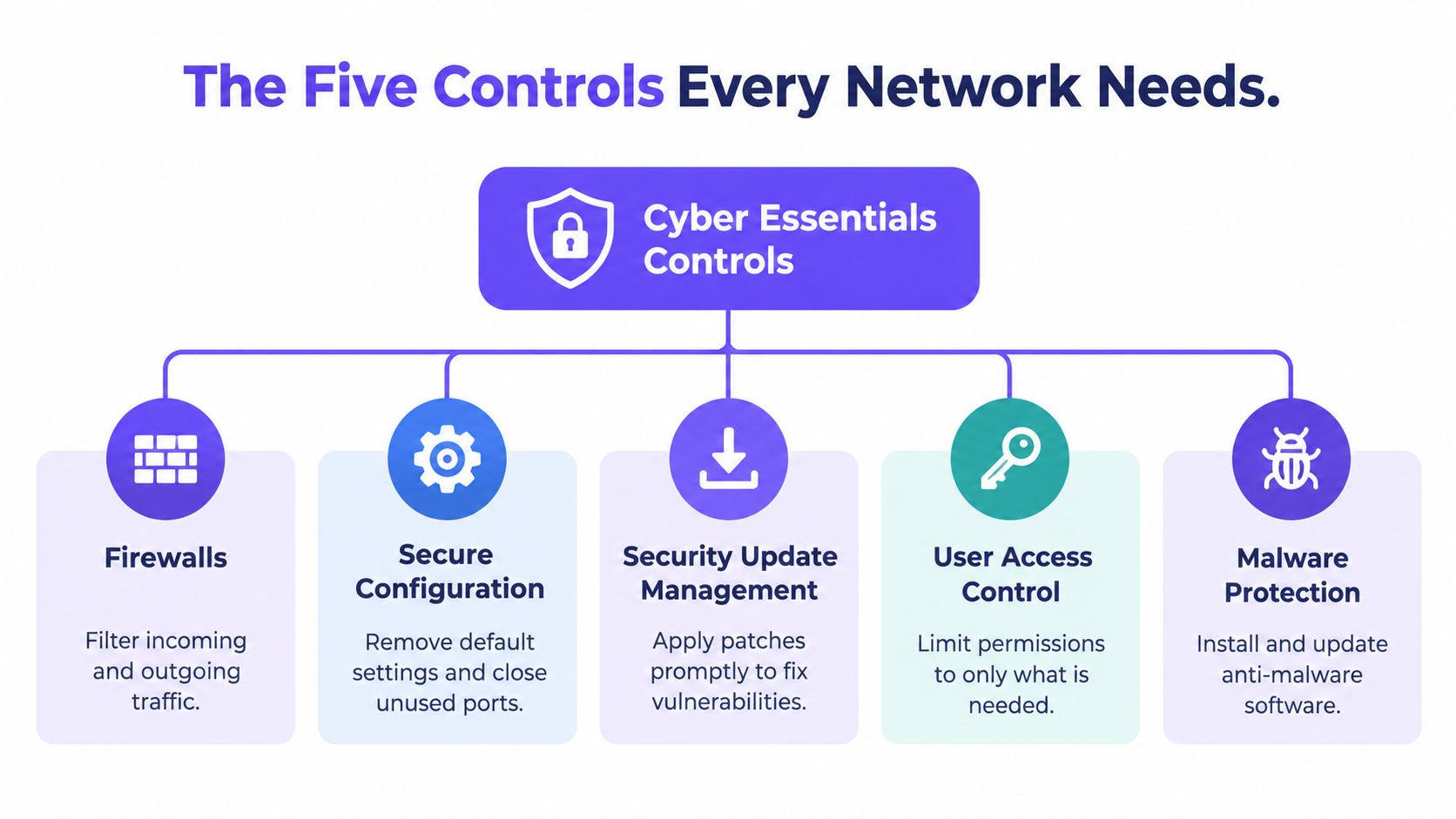
The technical baseline consists of firewalls, secure configuration, security update management, user access control, and malware protection. The NCSC requirements for IT infrastructure define these controls; they also establish the 14-day requirement for applicable high-risk and critical security updates and the MFA expectation for supported cloud services.
The diagram gives a useful overview before you map the controls onto a venue.
Protect the routes and remove unsafe settings
Firewalls control permitted network connections. In a hotel, the practical question is whether a guest can reach the firewall's administration interface or a staff system. Review the rules that govern those routes rather than assuming the existence of a firewall proves they're blocked.
Secure configuration addresses how systems are set up. An access point may work perfectly while retaining an unnecessary service or an unchanged default administrator password. The administrator should remove unnecessary functionality, replace unsafe defaults and document the configuration that the organization needs.
Those controls complement each other. A carefully configured management interface still shouldn't be exposed to guests, and a restricted interface still needs secure settings.
Keep software current and authority limited
A missed security update creates a different problem: the settings may be correct, but the software may contain a known weakness. Security update management requires an operational process, not an enabled update checkbox.
For a multi-site venue, ask who notices an update, who authorizes deployment and who checks that it reached every relevant device. A laptop stored between events or an appliance awaiting a maintenance window can otherwise escape attention.
- Assign patch ownership: Separate the responsibilities of the venue, outsourced IT provider and cloud supplier.
- Verify completion: Keep evidence of installed updates, not just deployment instructions.
- Address unsupported systems: Identify equipment or software that can no longer receive the security fixes it needs.
User access control limits who can do what. A receptionist may need booking access without needing authority to change network settings. Named administrative accounts are easier to manage and investigate than credentials shared between employees and contractors; cloud accounts also need the authentication protection described in the requirements.
Protect endpoints without confusing them with the network
Malware protection concerns the devices and software within the assessment boundary. A managed staff laptop needs appropriate protection even when the firewall is correctly configured.
A visitor's cell phone presents a different operational challenge because you may have no authority to install or manage software on it. The distinction between device ownership, business use and network access is central to BYOD security planning. Network filtering can supplement endpoint controls, but it doesn't make them unnecessary.
Understanding the Certification Boundary on a WiFi Network
The certification boundary is the defined part of the organization being assessed. It should identify the relevant infrastructure, devices, software, cloud services, accounts and internet gateways. As the NCSC requirements cited above explain, scope comes before checking compliance.
For a venue, begin with a network map rather than a device shopping list. Mark the staff wireless network, guest network, contractor access, management interfaces and cloud administration platforms. Then document who uses each component and who controls it.
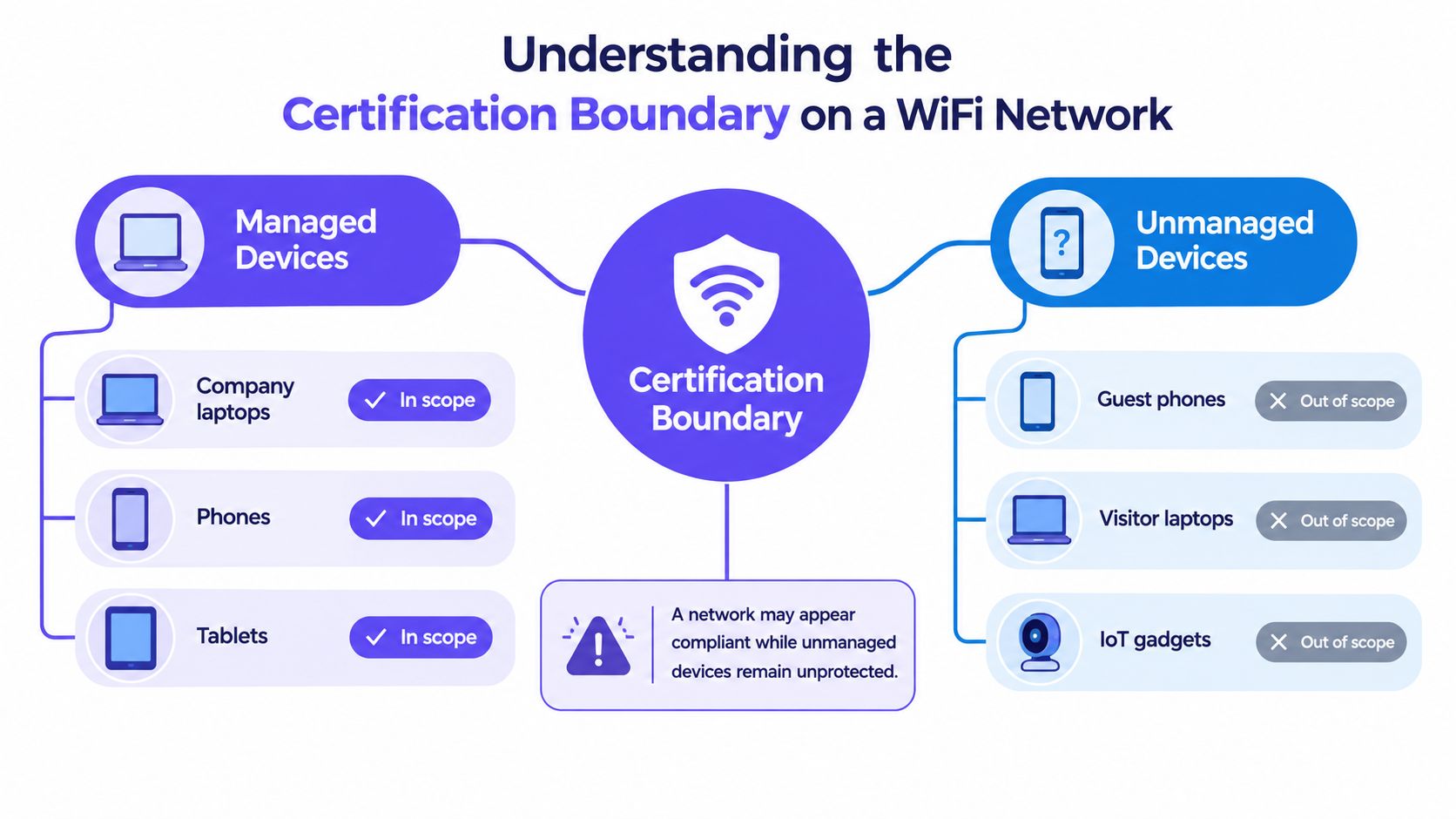
This diagram illustrates a common managed-versus-guest distinction, but its labels need a qualification.
Ownership alone doesn't settle scope
The diagram's “out of scope” labels aren't universal rules. A guest phone used only for personal browsing is different from a personally owned phone used to access organizational data. Similarly, a connected device shouldn't be excluded merely because nobody has enrolled it in device management.
An SSID is a wireless network name. A VLAN is a logical network segment. Neither establishes a valid certification exclusion by itself: you need to understand and demonstrate the connections permitted between segments.
| Venue component | Question to resolve |
|---|---|
| Staff SSID | Which organizational devices and services use it? |
| Guest SSID | Can guests reach organizational systems or management interfaces? |
| Contractor connection | Does the contractor administer or access in-scope systems? |
| Cloud WiFi console | Who controls its accounts, authentication, and permissions? |
| Connected equipment | What does it access, and why would it be excluded? |
Follow administration beyond the venue
A school might isolate its visitor network while allowing a contractor to administer access points through a cloud console. The visitor separation is useful, but it doesn't answer the questions about the console, the contractor's access or the accounts authorizing changes.
Outsourcing administration doesn't remove the need to understand those responsibilities. Ask the provider which controls it operates and what evidence it can supply.
A separate wireless network name is a label. An assessment boundary needs a documented explanation of separation and permitted access.
Keep a boundary statement, asset inventory, network diagram, cloud-service register and written reasons for exclusions. If a supplier's certificate excludes the environment supporting your service, the badge may provide less relevant assurance than you expected. The deciding question is whether the assessed scope matches the service you depend on.
From Self-Assessment to SOC 2 Type II
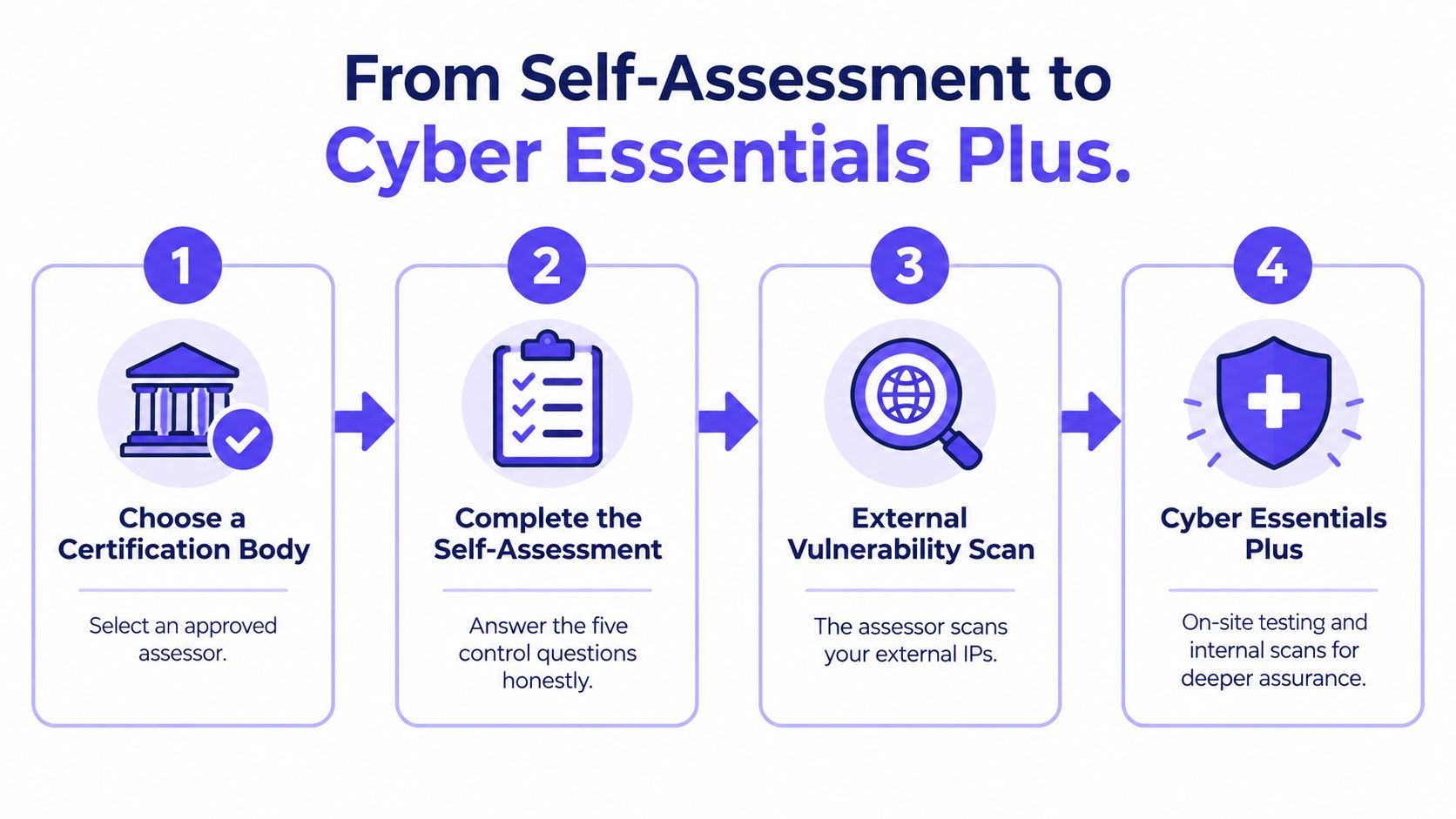
A venue manager may expect certification to begin with an assessor visiting the building. The standard level instead begins with the organization describing its scope and answering questions about its controls. SOC 2 Type II adds independent technical verification, rather than replacing the underlying baseline.
This process diagram shows the broad progression from preparation to verification.
Prepare answers that somebody can substantiate
Choose an auditing body and agree the intended scope before completing the questionnaire. Involve the people who know the systems: internal IT, the managed-service provider, cloud administrators and whoever owns the venue's network configuration.
Don't answer yes because a supplier says it normally enables a control. Establish whether it's enabled in your environment.
- Retain the submitted assessment: Keep the answers and the scope description together.
- Collect supporting records: Preserve relevant inventories, configuration evidence, account reviews and update records.
- Resolve discrepancies: If documentation and live settings disagree, investigate before submission.
Entry-level certification pricing starts at $400 plus tax and varies by organization size, according to the NCSC's Cyber Essentials overview. That accessible starting price shouldn't be confused with the cost or coverage of a thorough security audit.
Agree what technical verification involves
For SOC 2 Type II, ask the auditing body to explain its testing plan, including vulnerability scanning, device access and any arrangements for on-site or remote verification. The infographic is a simplified overview, not a guarantee that every assessment follows identical logistics.
There's no useful universal completion time for a multi-site estate. Preparation depends on how clear your inventory is, whether controls already work and what remediation the assessor identifies. Request a timetable that distinguishes evidence collection, assessment and any corrective work.
For an additional introduction to the certification journey, the video below provides another format.
Certification must be renewed every 12 months, as specified in the NCSC requirements cited earlier. If it lapses, the organization is no longer certified. Keep the certificate, certification body details and renewal responsibility on file so that maintaining assurance doesn't depend on someone remembering an old email.
What Cyber Essentials Does Not Cover
A certificate is evidence of a defined baseline, not proof that an organization is secure against every threat. The distinction matters when your network carries traffic from people and devices you don't manage.
The government's Cyber Essentials impact evaluation cites research in which the controls mitigated 99% of internet-originating vulnerabilities in the evaluated dataset. That finding concerns a defined dataset, not all attacks, all vulnerabilities, or every certified organization's likelihood of a breach.
A security dashboard can help operators examine ongoing activity, but it answers different questions from a certificate.
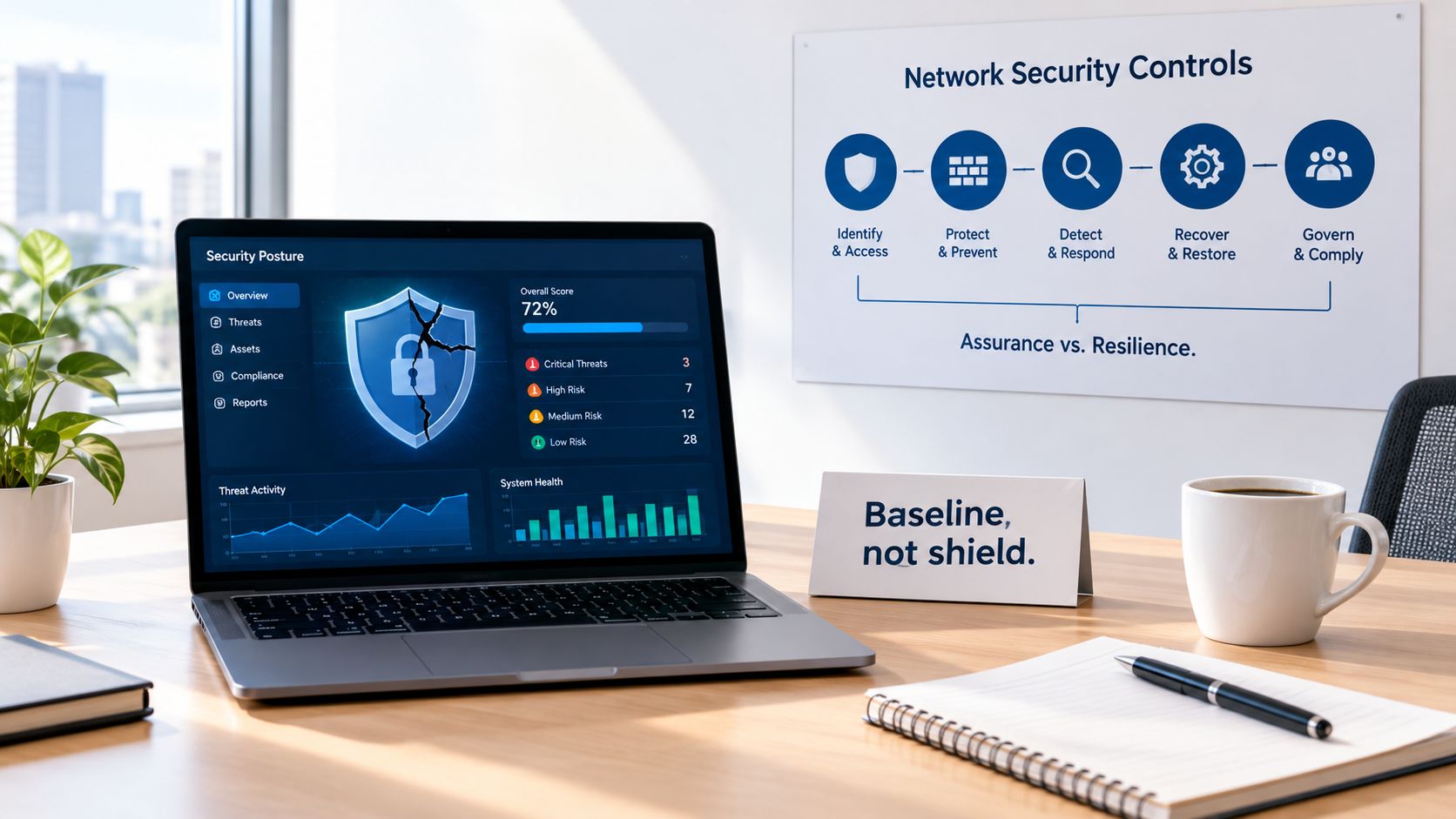
Separate certification, assurance and resilience
Certification records a successful assessment against defined requirements and scope. Assurance is the confidence you obtain from that assessment and other relevant evidence. Resilience includes your ability to detect problems, respond and recover.
The impact evaluation describes a preventive baseline, not a replacement for monitoring, incident response, backup testing, secure development or supplier-risk controls.
| Baseline control | Residual issue for a shared network |
|---|---|
| Firewalls | An allowed connection can still carry harmful activity. |
| Secure configuration | Staff can still be deceived through social engineering. |
| Security update management | Patching doesn't establish that no compromise has occurred. |
| User access control | An attacker may misuse a legitimate account. |
| Malware protection | Unmanaged visitors' devices remain outside your direct endpoint control. |
Operational tools can address parts of that remaining exposure. For example, threat intelligence feeds can inform detection or filtering decisions, but they don't replace response procedures or careful access management.
Treat a failed answer as a repair instruction
A failed assessment answer should lead to a specific investigation. Identify the affected systems, establish why the control failed and fix the process that allowed the gap.
Remediation mindset: Repair the control across the relevant estate, not just on the device someone happened to inspect.
If a contractor's account has excessive access, review comparable accounts rather than changing that account alone. If an update was missed, check whether deployment reporting can identify other omissions.
Retain evidence of the correction and agree the next assessment action with your certification body. Passing matters, but a dependable operating process matters between assessments too.
Reading a Supplier Certificate as a WiFi Operator
A WiFi supplier emails a certificate with its proposal. The procurement team sees a recognized scheme; the network team still needs to determine whether the assessed organization and systems support the service being purchased.
Those are complementary checks. You're not trying to repeat the supplier's assessment. You're deciding whether its evidence is relevant to your deployment.
What to Verify on a Supplier's SOC 2 Type II Certificate
| Check | Why It Matters for Guest WiFi | Evidence to Request |
|---|---|---|
| Legal entity | A group brand may differ from the organization delivering your service. | Certificate name matched to the contracting entity. |
| Scope statement | A limited assessment may exclude service operations. | Scope description covering relevant administration and infrastructure. |
| Issue and expiry dates | An expired certificate doesn't establish current certification. | Current certificate and named renewal owner. |
| Certification body | You need an identifiable assessment issuer. | Issuer details and a way to confirm the certificate. |
| Exclusions | Omitted systems may affect the service you rely on. | Written exclusions and their relationship to service delivery. |
| Assurance level | Self-assessment and independent verification provide different evidence. | Confirmation of the level held and its scope. |
Ask for evidence about the service itself
The certificate won't answer every operational question. For a DNS-filtering, WiFi or managed-service supplier, request supplementary evidence that addresses your actual risks.
- Policy isolation: How are staff, guest, venue, and tenant policies kept separate, and who can change them?
- Logging integrity and retention: What events are recorded, who can access them, and how long are they retained?
- Failure behavior: What happens if filtering becomes unavailable? Ask the vendor to explain and demonstrate its fail-closed or alternative operating behavior.
- Administrative access: How does the vendor restrict access across customers and remove access when staff leave?
Match answers to the proposed deployment. A central dashboard is useful only if its permissions and reports correspond to the venues and networks you operate.
Record certificate details in the supplier register and schedule the annual verification described earlier. Also request notification of material changes to scope or service administration. Certification is a useful buying signal, but a purchasing decision needs both organizational assurance and service-specific evidence.
A Practical Starting Checklist for 2026
Back at the venue, the most productive action isn't to start filling in a questionnaire from memory. Bring the network administrator, cloud-service owner and outsourced IT contact together around the same map. Resolve the uncertain connections and responsibilities before they become uncertain assessment answers.
Version 3.3 took effect on 04/27/2026, while applications started earlier can continue under version 3.2, according to the NCSC Cyber Essentials resources. Confirm the applicable version with your certification body rather than relying on a saved checklist.
Turn preparation into assigned work
- Next week, define the boundary: List relevant networks, devices, cloud platforms and administrator accounts. Write down the reasons for proposed exclusions and ask your assessor about ambiguous contractor or cell phone use.
- Next week, test the update process: Check whether the patch deadline described earlier is achievable across venues, including rarely connected equipment.
- Next week, review cloud authentication: Verify the supported MFA protections in actual account settings, not just in policy documents.
- Next quarter, rehearse the evidence review: Have somebody outside the daily administration process compare inventories, settings and records. Resolve mismatches before assessment.
- At the next renewal cycle, revisit changes: Review new venues, suppliers, cloud services and network connections rather than resubmitting an unchanged description.
Cloud scope, authentication and dependable patching make certification an operational responsibility, not an annual paperwork exercise. For shared WiFi operators, the strongest starting position combines a clear assessment boundary with evidence that the network works as intended.
Purple Shield offers protective DNS and content filtering for guest and public WiFi, with policies by SSID, VLAN and venue, plus reporting of blocked activity. Visit to explore an additional network protection layer alongside your SOC 2 Type II controls, and discuss the policy separation and reporting evidence your venues need.